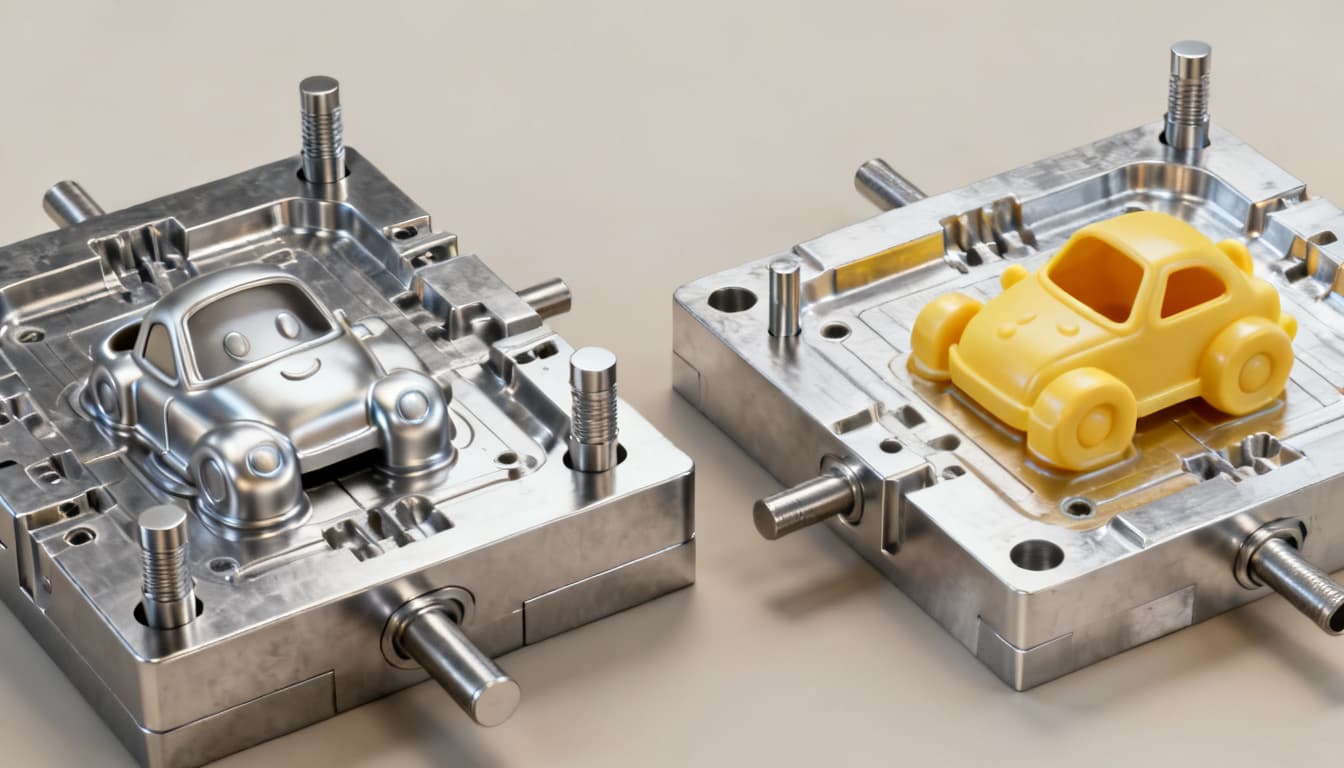
Steel vs. Aluminum Molds for Toy Novelties: A Cost-Per-Part Comparison Using 100,000-Unit Production Data
Seasonal novelty toys live and die by a six-week launch window. Miss the shelf date for a holiday collectible or a movie-tie-in figurine, and the revenue opportunity evaporates. That pressure to compress tooling lead times now collides with procurement mandates to drive down per-part costs across th
Why Toy Makers Are Re-Evaluating Mold Materials Right Now
Seasonal novelty toys live and die by a six-week launch window. Miss the shelf date for a holiday collectible or a movie-tie-in figurine, and the revenue opportunity evaporates. That pressure to compress tooling lead times now collides with procurement mandates to drive down per-part costs across the entire production run—not just the first 50,000 shots. For product engineers and injection molding buyers, the 100,000-unit production volume has become the critical inflection point where old rules of thumb about mold material selection break down. At this volume, aluminum and steel molds can both be viable, but the total-cost-of-ownership math demands real production data, not a spreadsheet inherited from a previous project.
The landscape has also shifted because the tooling supply chain has matured. Experienced injection molders like Panda Molding now routinely offer both aluminum and steel tooling paths from the same engineering team, giving buyers a single source for comparative quotes. That means the decision is no longer outsourced to the mold maker's preference—it sits squarely on the buyer's desk, where it belongs. A 100,000-unit toy run is large enough to expose the hidden costs of an under-spec aluminum mold yet small enough that a $30,000 hardened steel tool may never reach its break-even point. Understanding exactly where those lines cross is what this analysis delivers.
Key Takeaways: At 100,000 units, neither material wins by default. Cycle-time savings from aluminum can erase its shorter tool life, but only if the resin is unfilled, the texture requirements are moderate, and your demand forecast is reliable. If any of those variables change, the cost-per-part advantage flips—sometimes dramatically.
Thermal Conductivity, Hardness, and Cycle Time: The Physics Behind Mold Cost
Tooling economics start with physics. The reason aluminum molds can produce parts faster isn't a manufacturing trick—it's thermodynamics. Aluminum alloys used in injection molding, specifically 7075-T6 and QC-10 (Alcoa), exhibit thermal conductivity on the order of 100–130 W/m·K. Standard tool steels like P-20 and H-13 land around 24–30 W/m·K. That four-to-fivefold difference means an aluminum cavity extracts heat from the molten polymer much faster, solidifying the part in less time. Plastics Technology has documented that aluminum molds can reduce cycle time by 15–30% for thin-wall parts—a category that includes most toy novelty housings, figurine bodies, and interlocking brick-style components.
But thermal performance is only half the equation. Hardness dictates how many cycles that cavity can survive before wear degrades part quality beyond the tolerance band. The trade-off is stark and measurable, as the table below shows.
| Parameter | Aluminum (7075-T6 / QC-10) | Tool Steel (P-20 / H-13) | Engineering Significance |
|---|---|---|---|
| Thermal conductivity | 100–130 W/m·K | 24–30 W/m·K | Drives 15–30% faster cycle times for aluminum |
| Rockwell hardness | ~150 BHN (≈80 HRB) | 28–52 HRC (hardened) | Steel resists abrasive wear from filled resins |
| Density | ~2.8 g/cm³ | ~7.8 g/cm³ | Aluminum molds are lighter; easier handling but lower clamping rigidity |
| Typical shot life (unfilled ABS/PP) | 50,000–500,000 | 500,000–2,000,000+ | 100k-unit run sits inside aluminum's upper range |
| Shot life with 30% glass-filled nylon | 10,000–30,000 | 200,000–500,000 | Abrasive resins rapidly erode aluminum |
| Thermal expansion coefficient | ~23 × 10⁻⁶ /°C | ~11–13 × 10⁻⁶ /°C | Aluminum expands more; affects tight-tolerance shut-offs |
| Polishability (SPI standard) | A-3 to B-1 achievable | A-1 to A-2 achievable | Steel required for high-gloss optical finishes |
| Surface treatment options | Ni-PTFE, hard anodize, e-coat | Chrome plating, nitriding, PVD coatings | Coatings extend aluminum life but add cost and lead time |
| Typical lead time (2-cavity family mold) | 4–6 weeks | 8–12 weeks | Aluminum can shave 4–6 weeks off tooling delivery |
| Repairability | Limited; welding is difficult | Excellent; can be re-welded and re-cut | Steel molds can be refurbished for subsequent runs |
What the table doesn't capture is how surface coatings alter the equation. An uncoated QC-10 aluminum cavity running unfilled ABS might deliver 100,000–150,000 shots before texture degradation becomes noticeable. Apply a Ni-PTFE (nickel-polytetrafluoroethylene) coating, and the wear resistance improves by 30–50%, pushing the realistic shot life toward 200,000—well past the 100k-unit mark that triggers so much debate. The coating cost, typically $800–$1,500 per cavity side, must be folded into the tooling amortization, but it can shift the economic crossover point enough to make aluminum the definitive choice for borderline volumes.
Tip: When specifying aluminum molds for runs approaching 100k, always request a coating recommendation from your mold maker. The few hundred dollars in coating cost can prevent a mid-run polishing event that costs thousands in downtime and scrap.
Cost-Per-Part Showdown at 100,000 Units: Amortizing Tooling, Labor, and Maintenance
Let's move from physics to dollars. For this analysis, we'll use a realistic toy-novelty component: a two-cavity family mold producing ABS shell halves for a handheld collectible figurine. The part has a nominal wall thickness of 2.0 mm, a moderate matte texture (SPI C-1 equivalent), and no undercuts requiring side actions. Both mold options are quoted from the same tooling source to eliminate geographic or margin variance. The production scenario assumes a 180-ton electric press running in a Chinese manufacturing zone with fully burdened machine rates.
| Cost Metric | Aluminum Mold (QC-10, Ni-PTFE coated) | Steel Mold (P-20, hardened) | Selection Insight |
|---|---|---|---|
| Tooling cost (2-cavity family mold) | $9,500 | $26,000 | Aluminum tooling is roughly one-third the upfront investment |
| Cycle time (seconds) | 22 | 28 | Aluminum cuts 6 seconds per cycle; 21% faster |
| Parts per hour (2 cavities × cycles) | 327 | 257 | Aluminum yields 70 more parts per press-hour |
| Machine + labor rate (fully burdened) | $38/hr | $38/hr | Equal press rate; savings come from throughput |
| Piece price (labor + machine + resin at $1.80/kg) | $0.31 | $0.37 | Cycle-time advantage drives $0.06/part delta |
| Amortized tooling cost per part (100k units) | $0.095 | $0.26 | Steel carries 2.7× higher tooling burden per part |
| Maintenance/refurbishment at 80k shots | $2,500 (polish + insert check) | $0 (steel typically runs 100k without intervention) | Mid-run maintenance narrows the aluminum advantage |
| Amortized maintenance per part | $0.025 | $0.00 | Adds 2.5 cents per part to aluminum TCO |
| Total cost per part at 100,000 units | $0.43 | $0.63 | Aluminum saves ~$0.20/part; $20,000 across the run |
| Lead time (tooling delivery) | 5 weeks | 10 weeks | Five extra weeks of market availability can be revenue-critical |
The numbers tell a clear story at 100,000 units: aluminum wins by a margin of roughly $0.20 per part, translating to $20,000 in total program savings. But that margin is not unassailable. If your texture specification demands deep chemical etching that erodes aluminum cavities faster, or if the resin includes even 10% glass filler for rigidity, the maintenance line item balloons and the cycle-time advantage shrinks as the mold wears. Service providers such as Panda Molding can generate project-specific cost models that account for these variables, but the framework above gives you a solid baseline for internal discussions.
What's often overlooked is the interaction between mold material and scrap rate. Aluminum's higher thermal diffusivity means the cavity surface temperature stabilizes faster after startup and recovers more quickly between shots. In toy parts with varying wall thickness—common in figurines where the torso may be solid while limbs are thinner—this thermal stability reduces sink marks and warpage. A 2% scrap-rate reduction on 100,000 units equals 2,000 fewer rejected parts, adding another $600–$800 in savings that doesn't appear in the tooling amortization table but shows up on the P&L.
Choosing the Right Mold Material for Toy Novelties: A Field-Tested Decision Framework
The cost table is only useful if you know which column applies to your project. Toy novelties span an enormous range—from simple ABS spinning tops to multi-material action figures with overmolded elastomers. The decision framework below distills field experience into actionable gates. Run your project through these criteria before locking in a tooling purchase order.
| Decision Factor | Choose Aluminum When… | Choose Steel When… | Failure Boundary / Watch Point |
|---|---|---|---|
| Production volume | Firmly capped at 50k–150k units | Volume exceeds 150k or repeat orders are likely | If sales double unexpectedly, aluminum tool may die mid-run |
| Resin type | Unfilled ABS, PP, HDPE, or TPE overmold | Glass-filled nylon, PC, POM, or any filled grade | Even 10% glass fiber accelerates aluminum wear 5–10× |
| Surface finish requirement | Matte, light texture (SPI C-1 to B-2), or painted post-mold | High-gloss (SPI A-2 or better), deep chemical texture, or micro-etched patterns | Texture fidelity on aluminum degrades measurably after 80k shots |
| Lead time sensitivity | Seasonal launch window demands fastest tooling | Program timeline allows 10–12 weeks for tooling | Aluminum saves 4–6 weeks; critical for holiday novelties |
| Tolerance requirements | Commercial tolerance (±0.15 mm or looser) | Tight tolerance (±0.05 mm) on snap-fits or interlocking features | Aluminum's higher thermal expansion can cause dimensional drift |
| Post-mold operations | Parts will be painted, pad-printed, or metallized | Molded-in color with critical aesthetic consistency | Aluminum's glossier natural finish may not match steel-run parts |
| Budget profile | Upfront tooling budget is constrained; per-part cost is secondary | Total program cost (tooling + production) is the primary metric | Don't let a low tooling quote blind you to higher per-part costs at scale |
Plastics Technology research highlights an additional factor that tilts toward aluminum for many toy applications: reduced part warpage. In components with uneven wall sections—think of a dinosaur toy where the tail tapers from thick to thin—aluminum's faster, more uniform heat removal produces less differential shrinkage than steel. That means fewer rejected parts and less time spent tuning process parameters during first-article approval. For a product engineer staring down a tight launch deadline, that process stability is worth real money.
Beyond the table, here are the field-tested decision steps that experienced buyers follow:
- Lock your volume forecast first. If you genuinely cannot exceed 150,000 units (single-season novelty, limited-edition collectible), aluminum should be your default starting point. The cost math is too favorable to ignore.
- Test your resin on aluminum before committing. Even unfilled ABS can vary in abrasiveness depending on pigment loading and additive packages. Request a small test plaque from your mold maker to assess wear characteristics.
- Price a coated aluminum tool alongside bare steel. The Ni-PTFE or hard-anodize upcharge ($800–$1,500) may push the aluminum quote closer to steel, but the combined cycle-time and longevity benefit often delivers the best of both worlds.
- Plan a steel backup strategy for high-uncertainty volumes. If market response could push demand past 200k, ask your tooling partner like Panda Molding to retain the CAD and electrode data for a fast steel clone. The upfront cost is minimal; the insurance is invaluable.
- Don't overlook the revenue side of the lead-time equation. Five extra weeks on the market during peak season can generate more margin than all the tooling savings combined. If aluminum gets you to shelf faster, factor that revenue into your TCO model.
The mold material decision is never purely technical. It's a business case with engineering constraints. At 100,000 units, aluminum usually wins that case—but only when you've accounted for all the variables, not just the tooling invoice.
Toy Mold Material FAQ: Engineering Answers Beyond Cost Tables
Q: At what exact production volume does a steel mold become cheaper per part than an aluminum mold for a typical ABS toy?
Around 85,000–110,000 units for a simple two-cavity mold, assuming the aluminum tooling lasts 100,000 shots without major repair. The crossover depends heavily on cycle-time savings—aluminum often runs 20% faster—and on whether the aluminum mold needs mid-run polishing or insert replacement. In practice, the crossover is a range, not a single number, because maintenance timing varies with resin formulation, texture depth, and processing conditions. Many toy runs are unpredictable, so it's safer to model with a low, mid, and high scenario rather than a single breakpoint. If your maintenance event hits at 60k instead of 80k shots, steel can win at volumes as low as 75,000 units.
Q: Can an aluminum mold handle glass-filled nylon for a rugged toy component?
Not for long. Glass-filled resins are highly abrasive and will erode unprotected aluminum cavities after 10,000–30,000 shots, causing flash, dimensional drift, and deteriorating surface finish. If the run is under 10,000 units and post-mold trimming is acceptable, aluminum might limp through, but for 100,000-unit production, hardened steel is the only reliable choice. As a middle ground, aluminum with a thick Wear-Resistant Ni-PTFE coating can extend life to perhaps 50,000–75,000 shots with glass-filled nylon, but the coating cost and the risk of mid-run failure usually make steel the lower-risk, lower-total-cost option at production scale.
Q: How does mold material affect the surface finish of textured toy parts like dinosaur skin or brick surfaces?
Aluminum molds can reproduce fine textures well initially. The softer metal takes chemical etching or laser texturing with good fidelity. However, that texture fidelity degrades faster than steel—especially with repeated cycling, ejection stresses, and mold-cleaning abrasion. After 60,000–80,000 shots, a finely etched dinosaur-skin pattern on aluminum may show measurable shallowing, making the part look smoother and less detailed. For deep textures or high-frequency micro-etched patterns, the consistent hardness of P-20 or H-13 steel retains details for the entire 100k+ run. If a matte or soft-touch finish is critical, aluminum's faster heat transfer can actually improve replication of fine details in unfilled resins by keeping the polymer molten slightly longer at the cavity surface—but the longevity trade-off remains. Some molders address this by specifying a replaceable textured insert in aluminum, combining the thermal advantage with serviceability.
Q: We planned a 100k run with an aluminum mold, but sales doubled. Can we just switch to steel mid-production without re-engineering the part?
Switching mold material while keeping the same cavity geometry is possible but not trivial. Steel molds require different shrink factors because aluminum has roughly double the thermal expansion coefficient of steel. The cavity dimensions that produced an in-spec part from aluminum may yield a slightly oversized or undersized part from steel if not compensated. Also, the hotter-running aluminum surface often produces a glossier finish; steel may yield a slightly different aesthetic, especially on unpainted parts. A practical approach is to plan for a steel backup mold upfront if volumes are uncertain, or to work with a tooling shop like Panda Molding that can clone cavities in both materials with compensated dimensions derived from the same master CAD model. The incremental engineering cost is modest compared to the cost of scrambling mid-production.
Q: What additional cost factors beyond tooling and piece price should I include when comparing aluminum and steel molds?
Factor in four often-overlooked line items: (1) Maintenance and refurbishment—aluminum molds may need polishing or insert replacement after 60k–80k shots, adding $2,000–$4,000 to the program cost. (2) Extended cycle savings—quantify the energy and labor cost per part for the faster aluminum cycle; at 100k units, a 6-second cycle delta can save 160+ press-hours. (3) Scrap rates—aluminum's thermal stability can reduce sink marks in thick sections, potentially cutting scrap by 1–3%, which adds up at scale. (4) Opportunity cost of lead time—an aluminum mold can enable a 6-week earlier product launch, potentially capturing peak seasonal demand that a later steel-mold launch would miss entirely. A full total-cost-of-ownership model that includes these factors often shows aluminum winning at 100k units even when the raw tooling amortization looks less favorable on a simple spreadsheet.
Q: How do I verify a mold maker's aluminum-alloy grade is suitable for injection molding, not a cheaper casting alloy?
Specify 7075-T6 or QC-10 aluminum (Alcoa) for injection molds; these grades have the necessary hardness (approximately 150 BHN), polishability, and thermal-fatigue resistance required for production molding. Cheaper 6061 or generic casting alloys can gall under clamp forces, corrode from outgassing resins, or show poor surface finish after just a few thousand cycles. Ask for mill test certificates (MTCs) that confirm the alloy grade and temper, and ensure the shop machines from rolled plate rather than billet stock, which may contain inclusions or voids that propagate into surface defects. Reputable firms like Panda Molding provide material certifications as a standard part of their tooling package—if a shop hesitates to provide them, treat that as a red flag.
At 100,000 units, the steel-versus-aluminum decision for toy novelties comes down to specifics: your resin, your texture, your volume certainty, and your launch timeline. The cost tables point toward aluminum more often than many engineers expect, but the margin is thin enough that due diligence on each variable pays for itself. Get comparative quotes for both tooling paths, model the full TCO including maintenance and scrap, and don't let a single number—whether tooling cost or cycle time—drive the decision in isolation. For a project-specific breakdown tailored to your part geometry and production forecast, get a quote from an experienced molder who can walk you through both scenarios with your actual data.
References & Further Reading
- Plastics Technology — Injection molding industry publication with technical articles on mold materials, cycle-time optimization, and tooling economics.
- Panda Molding — Professional injection molding services offering both aluminum and steel tooling paths with project-specific cost modeling.
- Panda Molding Contact — Request a comparative tooling quote for your specific part geometry and production volume.
- Alcoa QC-10 Aluminum Mold Alloy — Industry-standard high-strength aluminum alloy formulated specifically for injection mold applications; available through Alcoa distribution partners.
- ASTM B221 — Standard specification for aluminum-alloy extruded bars, rods, wire, profiles, and tubes; relevant for verifying 7075-T6 mechanical properties.
- SPI Mold Finish Standards — Surface finish classification system (A-1 through D-3) used to specify polish and texture requirements for injection mold cavities.