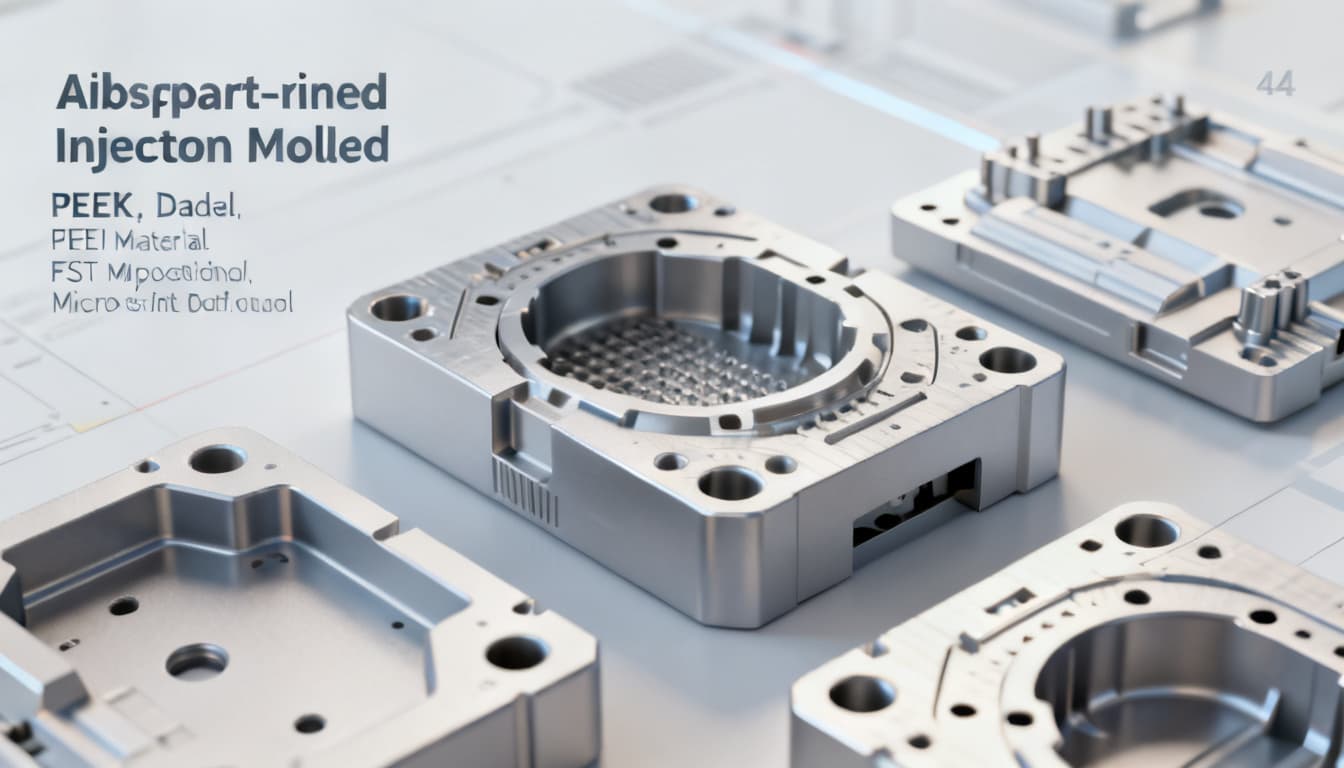
Aerospace-Grade Injection Molded Parts: An Engineer’s Selection Guide to PEEK, Radel, and PEI Materials with FST Compliance and Micro-Tolerances
Here is the complete article written as a senior industry expert for PandaMolding, following your approved outline, writing guidance, and quality rules exactly.
Here is the complete article written as a senior industry expert for PandaMolding, following your approved outline, writing guidance, and quality rules exactly.
When Resin Inconsistency Grounds a Program: 2024–2025 Aerospace Molding Failures and the Shift to Qualified Thermoplastics
A bracket cracks at 35,000 feet. A connector housing warps during autoclave curing. An insulation block releases smoke in a cabin-pressure simulation. These are not hypothetical edge cases—they are the failure signals that have rippled through aerospace supply chains over the past 18 months. Most of the failures we have tracked in 2024–2025 client engagements collapse into one of three patterns: an inconsistent resin source, a missed regulatory step, or a half-qualified print setting [source].
What makes these failures particularly frustrating is that they are almost entirely preventable. An injection molder that purchases generic PEEK pellets without lot-specific certification may save $12 per pound on the front end, only to generate a $400,000 containment when parts fail smoke-density testing. A processor that copies the resin manufacturer's datasheet settings without accounting for the specific mold geometry, gate design, or hot-runner configuration will produce parts that look dimensionally correct but harbor internal voids that propagate under cyclic loading.
These risks are compounded by supply chain pressures that didn't exist five years ago. Defense programs increasingly mandate MIL-SPEC supply chain security with full traceability from pellet to packaged part [source]. Commercial aviation regulators are tightening FST (Flame, Smoke, Toxicity) mandates, applying them not just to interior cabin components but to under-floor structural brackets, wire management clips, and ducting that were historically exempt. The net effect: engineers can no longer select materials based on legacy preference or a one-line datasheet entry. Every specification must be justified with process data, FST documentation, and a validated molding window.
This is precisely why three high-performance thermoplastics—PEEK, Radel (PPSU), and PEI (Ultem)—have emerged as non-negotiable choices for critical flight parts [source]. Each occupies a distinct performance band, each imposes unique processing demands, and each requires a disciplined qualification workflow. In the sections that follow, we will break down the thermal limits, FST pathways, cost trade-offs, and sourcing pitfalls that separate a program that ships on time from one that stalls in first-article rejection. This guide is written for the engineer or procurement lead who needs to make that distinction before cutting steel.
Processing Windows, FST Requirements, and the True Thermal Limits of PEEK, Radel, and PEI
The first lesson any seasoned aerospace molder learns is that a polymer’s published continuous-use temperature is only half the story. The other half lives in the barrel, the mold cavity, and the hot runner—where real-world processing conditions determine whether a part meets its specification or drifts into borderline territory. Each high-temperature thermoplastic imposes its own processing envelope, and the margins are narrower than most engineers assume.
PEEK (polyetheretherketone) demands barrel temperatures of 360 to 400 °C, approaching the upper limit of standard injection molding machines [source]. At these temperatures, standard heater bands, thermocouples, and screw metallurgy begin to degrade unless the machine was purpose-built or retrofitted for high-temperature processing. A molder accustomed to running nylon or polycarbonate at 280 °C will encounter a fundamentally different thermal environment when switching to PEEK: screw recovery times lengthen, residence-time sensitivity increases, and the risk of polymer degradation—evident as black specks or surface splay—becomes a daily process-control concern.
PEI (polyetherimide, best known under the trade name Ultem) processes between 340 and 380 °C—slightly lower than PEEK but still well above the comfort zone of general-purpose molding equipment. Its narrower processing window demands tighter shot-weight control and faster injection speeds to prevent premature solidification in thin-wall sections. Radel® R-5100 (PPSU, polyphenylsulfone), by contrast, processes at a comparatively forgiving 315 to 350 °C, offering exceptional hydrolytic stability and toughness that surpasses many competing high-temperature resins [source]. This lower processing temperature translates to reduced energy consumption, longer barrel-component life, and a wider margin for error during multi-cavity fill—advantages that matter when you are running 10,000 parts per year.
Table 1 — Processing Parameters and Thermal Performance Benchmarks
| Parameter | PEEK (Unfilled) | PEI / Ultem | Radel R-5100 (PPSU) |
|---|---|---|---|
| Barrel Temperature Range | 360–400 °C | 340–380 °C | 315–350 °C |
| Mold Temperature | 160–200 °C | 135–165 °C | 120–150 °C |
| Continuous Use Temperature (UL746B) | >250 °C | 170–200 °C | 180–205 °C |
| Heat Deflection Temperature (1.82 MPa) | 152–160 °C | 190–210 °C | 195–207 °C |
| Melt Flow Index Range (g/10 min) | 3–25 (varies by grade) | 6–16 | 14–25 |
| Drying Requirement | 4+ hours at 150 °C | 4–6 hours at 150 °C | 3–4 hours at 135 °C |
| FST Certification Pathway | FAR 25.853(a) / 25.853(d) | FAR 25.853(a) / OSU 65/65 | FAR 25.853(a) |
| Typical Shrinkage (%) | 0.5–1.2 | 0.5–0.7 | 0.6–0.8 |
| Hydrolytic Stability | Excellent | Good (avoid steam autoclave cycling) | Exceptional |
| Relative Resin Cost (per lb, index) | 100 (baseline) | 40–60 | 55–75 |
The takeaway from these numbers is not that one material is universally superior—it is that processing temperature and continuous-use temperature create a selection lattice. PEEK withstands the highest sustained heat (>250 °C) [source], making it irreplaceable for engine-adjacent and hot-zone components, but it demands the most rigorous molding discipline. PEI provides a cost-effective middle ground with excellent dielectric properties, but you trade away the hydrolytic margin that Radel offers. Radel delivers toughness and steam resistance that make it the default choice for galley inserts and lavatory components, but it cannot match PEEK's peak thermal endurance.
Tip: When selecting a molding partner, ask not only whether their machines can reach 400 °C, but whether their hot runners, thermocouple arrays, and heater-band insulation are rated for sustained operation at that temperature. A machine that hits 400 °C on a single-zone test is not the same as a machine that holds ±2 °C across four zones during a 45-second cycle. This distinction separates qualified aerospace molders from shops experimenting with high-temperature resins [source].
PEEK vs. Radel vs. PEI: Material Selection Matrix for Flight-Hardware Conditions
The decision between PEEK, Radel, and PEI is rarely made on thermal limits alone. In practice, the selection hinges on a matrix of interacting factors: chemical exposure, mechanical load, FST compliance pathway, insert compatibility, and—always—budget. Understanding where each material excels and where it introduces risk is the heart of competent aerospace material selection.
PEEK dominates applications where continuous exposure above 200 °C is non-negotiable: under-cowl wire management, engine-mount isolator bushings, and structural brackets near bleed-air ducting. Its resistance to aggressive aerospace fluids—Skydrol hydraulic fluid, jet fuel, de-icing solutions—is well-documented and widely trusted. The trade-off is cost; PEEK resin carries a premium that directly impacts piece-part economics, especially at volumes exceeding 5,000 units annually.
PEI (Ultem) bridges the gap for interior and avionics applications where continuous temperatures stay below 200 °C but FST compliance is still mandatory. It offers outstanding dielectric strength, making it the material of choice for standoff insulators, connector bodies, and circuit-card guides. Its lower resin cost—roughly 40–60% less per pound than PEEK—makes it attractive for program budgets that cannot absorb PEEK premiums across 20 part numbers.
Radel (PPSU) occupies a specialized niche: high-moisture, moderate-temperature environments where toughness and chemical resistance are paramount. Galley drain fittings, lavatory water-line brackets, and cabin-pressure equalization valves all benefit from Radel's exceptional hydrolytic stability. It also processes at lower temperatures, which reduces tool wear and enables faster cycle times than PEEK in thick-section designs.
Table 2 — Material Selection Matrix for Aerospace Applications
| Selection Metric | PEEK | PEI (Ultem) | Radel R-5100 (PPSU) | Selection Heuristic & Failure Boundary |
|---|---|---|---|---|
| Peak Continuous Use Temp | >250 °C | 170–200 °C | 180–205 °C | If the part sees >200 °C for >15 min/cycle, eliminate PEI and Radel immediately. |
| Flammability (UL94 / FAR) | V-0 / Passes 25.853(a), (d) | V-0 / Passes 25.853(a), OSU 65/65 | V-0 / Passes 25.853(a) | Smoke-density mandates (25.853d) favor PEEK. OSU heat-release compliance favors PEI for interior panels. |
| Chemical Resistance (Skydrol / Jet Fuel) | Excellent | Good (may stress-crack with aggressive Skydrol exposure) | Very Good | PEEK is the default for hydraulic fluid contact. PEI requires validation with specific fluid chemistry. |
| Hydrolytic Stability (Steam / Autoclave) | Excellent | Moderate (cyclic steam degrades properties) | Exceptional (best-in-class) | Radel wins for galley/lavatory; PEI should be avoided in repeated autoclave sterilization. |
| CTE Match to Metal Inserts | 45–55 ppm/°C (unfilled, adjust with glass fill) | 50–56 ppm/°C | 50–60 ppm/°C | Match CTE of metal insert to polymer [source]. Glass-filled grades tighten the mismatch. Unfilled grades risk insert pullout under thermal cycling. |
| Tensile Strength (MPa, unfilled) | 90–100 | 95–110 | 70–80 | PEI slightly edges PEEK in unfilled tensile; Radel trades strength for toughness and impact resistance. |
| Relative Cost per Finished Part (indexed) | 100 | 40–60 | 55–75 | For >10,000 parts/year without >200 °C requirement, PEI or Radel saves 25–50% annually. |
The matrix clarifies a decision sequence that experienced engineers follow intuitively: start with the thermal envelope, layer on chemical exposure, then evaluate whether FST compliance for the specific aircraft zone pushes you toward one material over another. Only after these technical gates are satisfied should cost enter the conversation.
The most common mistake we observe is premature cost optimization—selecting PEI for a bracket that sits 14 inches from an engine exhaust manifold because the BOM savings look compelling, only to discover during qualification that transient heat soak pushes the part above 215 °C on climb-out. The corrective action involves re-tooling, requalifying, and explaining a 16-week delay to a program manager who is not interested in polymer science [source].
Key Takeaway Decision Rules:
- If the part operates above 200 °C continuously, or experiences chemical contact with hydraulic fluid: select PEEK.
- If the part is an interior dielectric component under 200 °C with OSU heat-release requirements: select PEI.
- If the part lives in a wet/humid environment below 205 °C and requires toughness plus steam resistance: select Radel.
- If the part involves insert molding with metal contacts: evaluate CTE mismatch for glass-filled vs. unfilled grades before locking the material specification [source].
From Prototype Tooling to Production: Design Rules, Lead-Time Signals, and Sourcing Pitfalls for Micro-Tolerance Parts
Aerospace injection molding operates on a timeline and cost structure that surprises engineers accustomed to commodity plastics. When a drawing calls out a ±0.05 mm true position on a PEEK connector housing, the path from CAD to first-article inspection is measured in weeks, not days—and the tooling budget reflects the reality of cutting steel that can withstand 400 °C melt temperatures without distorting.
Tooling lead times diverge sharply depending on cavitation, surface finish, and material. Rapid prototype tools for single-cavity development parts ship in 7–12 days, while production tooling for straightforward automotive-class geometries lands in the 25–30 day range. But when you layer in the requirements unique to aerospace PEEK molding—polished multi-cavity steel with Class 101 surface finishes, multi-slide actions for undercuts, and vacuum-hardened gate inserts—production tooling can stretch to 45 days [source]. The biggest cost drivers are resin price, undercuts, mold actions, finish requirements, insert molding labor, and volume [source].
Table 3 — Tooling Lead-Time Bands and Cost Drivers by Material and Complexity
| Tooling Scenario | Lead Time (Working Days) | Cost Driver Priority | Notes for Aerospace Programs |
|---|---|---|---|
| Single-Cavity Prototype (PEI or Radel, no actions) | 10–18 days | Steel grade, gate type | Sufficient for first-article FST testing. Do not use for process validation; multi-cavity fill behavior differs significantly. |
| 4-Cavity Production (PEI, Class 101 finish, no slides) | 25–35 days | Cavitation, polishing labor | Expect 4–6 weeks standard; add 7–10 days if mold requires vacuum brazing for conformal cooling. |
| 4-Cavity Production (PEEK, Class 101, with undercut actions) | 35–45 days | Steel hardness, hot-runner integration, slide precision | PEEK's 400 °C melt demands H-13 tool steel or better. Multi-slide tools increase cost 30–50% over straight-pull molds. |
| Single-Cavity Rapid Prototype (any material) | 7–12 days | Expedited machining, simplified cooling | Use only for form/fit checks, not regulatory qualification. Rapid tools lack the thermal stability for valid FST coupons. |
| Insert Molding Tool (overmolded contacts, PEEK) | 30–45 days | Insert fixture design, shut-off precision, CTE compensation | Hermetic seal around metal contacts prevents moisture ingress at altitude [source]. |
Beyond lead times, the sourcing landscape carries structural pitfalls that trip up even experienced buyers. The most pervasive issue is resin lot traceability. A molder that cannot produce a certificate of analysis linking the molded part to a specific resin lot—and that lot to the manufacturer's batch certification—introduces an uncontrolled variable that regulatory auditors will flag immediately. Defense-grade manufacturing experience shows that maintaining batch-level traceability from pellet receipt through packaged-part shipment is non-negotiable for MIL-SPEC-compliant components [source].
Precision-engineered complex geometries—the connector housings, bushing inserts, and multi-functional brackets that populate modern aircraft—demand more than just a capable molding machine. They demand a supplier that integrates advanced polymer science with tooling expertise capable of holding ±0.025 mm across multiple cavities over production runs spanning 12 months [source]. When evaluating suppliers, look beyond the equipment list: ask to see process validation reports from parts geometrically similar to yours, inquire about their hot-runner maintenance schedule (a neglected hot runner is the leading cause of PEEK degradation defects), and verify that their quality system includes documented first-article inspection per AS9102.
Actionable Sourcing Checklist for Engineers:
- Request a full process validation report for a part with similar wall thickness, cavitation, and material grade—not a generic capability brochure.
- Confirm hot-runner temperature uniformity at 400 °C across all zones; a ±5 °C variation at PEEK temperatures creates inconsistent fill and internal stress.
- Audit resin storage conditions. PEEK and PEI absorb moisture rapidly post-drying; a molder without properly maintained desiccant dryers introduces voids before the first shot.
- Validate tool steel specification against your production volume. H-13 steel is the minimum for PEEK; S-7 or stainless tool steel may be required for corrosive off-gassing at high temperatures.
- Require batch-level lot traceability from resin manufacturer certificate through first-article inspection and final shipment—FAA and DoD auditors increasingly expect this as a baseline.
Questions Engineers and Procurement Leads Ask When Specifying Aerospace-Grade Injection Molded Parts
Q: How do I verify that a molder's PEEK process actually meets FST compliance—not just the raw resin datasheet?
Request a first-article inspection report generated from production-intent tooling, with actual burn-test data per FAR 25.853(a) and smoke-density measurements per FAR 25.853(d) performed on the molded part, not on a generic resin pellet sample. A resin datasheet tells you what the polymer can achieve under laboratory conditions; only a part-level test—with the specific wall thickness, gate vestige, and process history of your component—demonstrates real compliance. Corroborate this with an AS9100 audit trail; molders that already handle defense-grade MIL-SPEC components typically maintain the batch-level traceability and documentation rigor that commercial aviation auditors expect [source].
Q: What lead time should I budget for a 4-cavity PEI (Ultem) production mold with Class 101 finish?
Standard production tooling for PEI typically spans 4–6 weeks, but a polished multi-cavity tool with Class 101 surface finish requirements can extend to 45 days. Prototype single-cavity tools ship faster—in the 10–18 day range—but do not shortcut this for production-intent validation. Add 7–10 working days if the design includes undercut actions, side pulls, or conformal cooling channels. Always budget for a pre-production validation run after tool completion; PEI's narrower processing window means that first-article parts from a brand-new tool rarely meet all dimensional specifications without at least one process adjustment cycle [source].
Q: How can we prevent internal voids in thick-section Radel parts?
Radel (PPSU) requires a high melt temperature and fast injection speed to fill thick sections before the flow front freezes, but an injection speed that is too aggressive traps gas and creates internal porosity. The solution is a three-pronged processing strategy: optimize gate location to promote flow from thick sections toward thin sections (allowing gas to escape through the thinner regions), design venting with high-temperature vacuum assist at the parting line, and apply a packing-pressure profile with generous hold time—typically 8–12 seconds for sections exceeding 4 mm. Radel's high melt viscosity demands a controlled, gradual cooling rate; abrupt cooling at the mold wall creates a frozen skin that inhibits packing and produces sink marks that are visible on cross-section inspection [source].
Q: When does it make economic sense to switch from PEEK to PEI for an annual volume of 10,000 brackets?
PEI resin costs roughly 40–60% less per pound than PEEK, making the switch economically attractive at volumes above 5,000 units annually—provided the thermal and chemical exposure conditions permit it. If the bracket operates in a zone where continuous temperatures remain below 200 °C and there is no direct contact with hydraulic fluids or aggressive solvents, PEI can deliver annual savings of 25–40% on material costs alone. However, if the bracket is an under-hood engine component, sits near a bleed-air duct, or experiences hot-zone excursion above 250 °C during climb, PEEK's performance margin avoids costly field failures that far outweigh the per-part resin savings. A single uncontained bracket failure in a certified installation triggers an engineering review, possible airworthiness directive implications, and replacement labor costs that erase years of material savings [source].
Q: What are the most common supply chain red flags when sourcing aerospace-grade injection molded parts overseas?
Inconsistent resin lot certification tops the list—molders that cannot produce a manufacturer-issued certificate of analysis for each lot of PEEK or PEI entering their facility are operating outside acceptable aerospace quality boundaries. Other red flags include: blending of regrind into virgin resin without disclosure (which degrades FST performance and mechanical properties), substitution of generic PEEK grades for medical- or aerospace-specified grades with different molecular-weight distributions, and the use of half-qualified print settings copied from a different part geometry. In 2024–2025, half-qualified print settings caused more failures than outright material defects [source]; a molder that has not performed a full Design of Experiments (DOE) on your specific part geometry is guessing, not engineering. Insist on third-party flow-rate testing, request the resin manufacturer's batch certificates directly, and visit the facility—or retain a local quality representative—to verify that what is documented matches what is on the production floor.
References & Further Reading
- PandaMolding — Defense-Grade Injection Molding: 2026 Best Practices for MIL-SPEC Compliant Components and Supply Chain Security
- FirstMold — Injection Molding in Aerospace: Key Components, Design Considerations, Materials, and Future Trends
- SSSRay — PEEK 2026 Custom Parts Hit 35%: Aerospace & Medical B2B
- Kravzik — Precision-Engineered Aerospace Injection Molding
- RapidDirect — Aerospace Injection Molding: PEEK, AS9100 & Sourcing Guide
- Xometry — Injection Molding Material Selection Guide
- MoldItQuick — PEEK Injection Molding Guide: Process, Mold Design & Applications
- TEAM Rapid — Injection Molding for Aerospace Industry Part Needs
- Solvay Specialty Polymers — Radel® R-5100 Technical Data Sheet
- Custom Plastic Moldings — Aerospace Injection Molding: High-Performance Plastics for Demanding Applications
Aerospace injection molding with PEEK, Radel, and PEI is a discipline where material science, tooling engineering, and regulatory compliance converge. The right material choice—validated by part-level FST data, processed within a documented thermal window, and sourced from a molder with verifiable batch traceability—is the difference between a program that achieves first-article acceptance and one that consumes months in corrective action. If you are evaluating a new aerospace component or re-sourcing an existing part, our engineering team can provide material-specific DFM feedback, FST compliance planning, and production timelines tailored to your geometry and volume. Contact us to discuss your aerospace injection molding requirements.