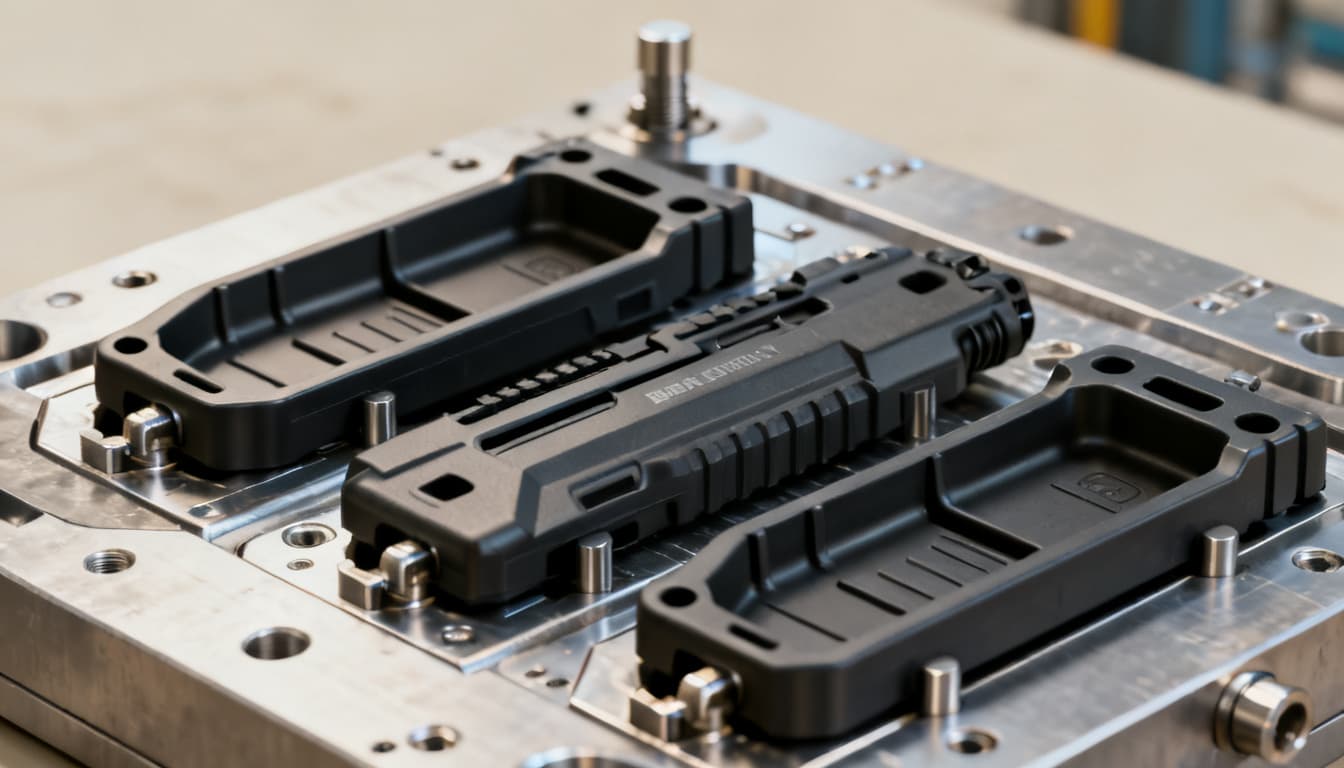
2026 Best Practices for Defense Injection Molding: Achieving Ballistic Resistance, Zero-Defect Traceability, and ITAR-Compliant Production
Defense injection molding in 2026 sits at a peculiar intersection. On one side, you have the physics of stopping a projectile—polymer morphology, melt homogeneity, and post-mold annealing that determine whether a component survives a ballistic event or shatters. On the other, you have the paperwork:
2026 Best Practices for Defense Injection Molding: Achieving Ballistic Resistance, Zero-Defect Traceability, and ITAR-Compliant Production
Defense injection molding in 2026 sits at a peculiar intersection. On one side, you have the physics of stopping a projectile—polymer morphology, melt homogeneity, and post-mold annealing that determine whether a component survives a ballistic event or shatters. On the other, you have the paperwork: ITAR-controlled digital threads, AS9102 First Article Inspection Reports, and lot-level traceability that traces every gram of resin back to its reactor batch. Few manufacturing sectors demand that you master both simultaneously, and fewer still punish failure in either domain as severely.
This article maps the terrain for product engineers and injection molding buyers who need to qualify defense components in 2026. We will walk through polymer selection for ballistic resistance, compare mold steels that survive corrosive flame-retardant compounds, build a traceability framework that satisfies ITAR auditors, and equip you with the pre-sourcing questions that separate competent molders from checkbox-fillers. Every recommendation draws on field-validated references, from Noble Plastics' work on virtual molding for defense complexity to Westec Plastics' structured approach to zero-defect manufacturing.
From MIL-STD-810 Shock Tests to ITAR Audits: The Dual Pressure on Defense Molders
The procurement landscape has shifted. A decade ago, a defense molder could win business by demonstrating clean dimensional capability and passing a handful of mechanical tests. Today, the same shop must prove that its process data is locked down under ITAR access controls and that its molded housings survive the full MIL-STD-810 shock-and-vibration battery. The two demands are not additive—they are multiplicative.
Consider the requirements outlined by TechNH's defense injection molding specifications: molded components must function across temperature ranges from -65°F to +160°F or beyond, resist UV degradation over multi-year deployment cycles, survive mechanical shock and vibration per MIL-STD-810, and maintain structural integrity despite prolonged chemical exposure to fuels, decontaminants, and lubricants. Meeting any one of these is straightforward; meeting all four while maintaining full material traceability and restricting foreign-national access to tooling drawings is where most shops stumble.
Key Takeaway: The 2026 defense molder is evaluated on two axes—mechanical survivability and data governance. A shop that excels at one but is weak on the other will fail a source inspection within the first hour.
Noble Plastics, in their analysis of defense injection molding complexity, points to virtual molding software as a force multiplier. Simulation tools like Autodesk Moldflow compress the prototyping cycle by modeling fill patterns, knit-line locations, and residual stress before a single steel chip is cut. The result: shorter lead times and faster collaboration between design teams and manufacturers. But Noble is careful to note that simulation accelerates the iterative loop—it does not replace the physical qualification. A simulated drop test is not a MIL-STD-810 drop test, a distinction we will return to in the FAQ.
The dual pressure is structural, not cyclical. ITAR enforcement is tightening, not loosening. Ballistic threats are evolving. And the margin for error on both fronts is zero.
Polymer Selection and Process Science for True Ballistic Resistance
Ballistic resistance in an injection-molded part is not simply a material property—it is a process outcome. Two molders running the same polycarbonate grade can produce parts with dramatically different impact behavior depending on melt temperature, injection speed, packing pressure, and cooling rate. The mechanism is molecular: ballistic impact propagates through a polymer at the speed of sound in that medium, and the energy dissipation depends on whether the polymer chains are oriented, entangled, and free of frozen-in stress concentrations.
The Xometry Injection Molding Design Guide catalogs impact-resistant materials from polypropylene to rigid engineering thermoplastics, but defense applications narrow the field considerably. You need polymers that maintain ductility at -65°F, resist chemical degradation from CLP cleaners and JP-8 fuel, and deliver repeatable multi-hit performance. The Injection Molding Handbook's third edition reinforces this by detailing how plastic characteristics—melt rheology, crystallization kinetics, and thermal degradation thresholds—interact with joining and assembly methods for multi-component defense parts such as overmolded armor inserts and bonded optical housings.
The table below maps four polymer families against defense-relevant ballistic and environmental criteria. Use it as a starting point, not a final answer—your specific threat level, geometry, and process will shift the rankings.
| Polymer | Ballistic Mechanism | Temperature Range | Chemical Resistance | Typical Defense Application | Process Sensitivity |
|---|---|---|---|---|---|
| Polycarbonate (PC) | Ductile yielding; large plastic deformation zone absorbs kinetic energy | -40°F to 250°F | Poor vs. solvents; good vs. dilute acids | Transparent armor laminates, face shields | High—residual stress causes crazing and premature ballistic failure |
| Nylon 6/6 (PA66) | Toughening via craze formation and shear banding; conditioned moisture improves ductility | -65°F to 300°F (dry); embrittles when dry at low temp | Good vs. hydrocarbons; swells in water | Magazine bodies, stock components, gear housings | Moderate—moisture conditioning step is non-negotiable for cold-temperature impact |
| PEEK (unfilled) | High strain-rate sensitivity; maintains stiffness and energy absorption at elevated temps | -65°F to 500°F continuous | Excellent—resistant to nearly all solvents, fuels, and acids | Thermal battery insulators, blast-resistant connector bodies | Very high—requires 700°F+ melt temps and oil-heated molds; narrow processing window |
| Ultra-High Molecular Weight PE (UHMWPE) | Extreme chain entanglement; fiber-reinforced grades (Dyneema, Spectra) stop projectiles via sequential fiber failure | -100°F to 180°F | Excellent—inert to most chemicals | Spall liners, ballistic panel backers | Low for injection molding—UHMWPE does not flow; compression molding or fiber layup is standard, limiting complex geometry |
Tip: When qualifying polycarbonate for transparent armor, specify a post-mold annealing cycle—typically 250°F for 2–4 hours in a controlled oven—to relieve molded-in stress. Skipping this step is the single most common reason PC armor laminates fail first-shot ballistic testing. The annealing step should be documented in the process sheet and verified with polariscope inspection before lamination.
For multi-component defense assemblies—think overmolded soft-touch grips on a weapon housing or a chemically bonded seal on a battery enclosure—the process science extends beyond the molding machine. Joining methods matter. The Injection Molding Handbook's chapter on adhesives and solvent bonding is essential reading here: a solvent-bonded joint that looks perfect under ambient inspection can delaminate catastrophically at -65°F if the solvent selection did not account for differential thermal contraction between the substrate and the adhesive layer.
S136 vs. H13 Mold Steel: Which Delivers Truly Zero-Defect Tool Life in Corrosive Defense Compounds?
Defense formulations are chemically aggressive by design. Brominated flame retardants, required to meet MIL-STD flammability requirements, generate acidic byproducts at molding temperatures that attack tool steel. Glass-filled nylons, ubiquitous in structural defense components, are abrasive enough to erode gates and parting lines. And the stakes of tool degradation are higher than in commercial molding: a cavity that drifts 0.001 inch out of spec between lot runs can create a dimensional nonconformance that triggers a full containment investigation, halting shipments and burning engineering hours.
The mold steel decision—S136 vs. H13—is therefore not a procurement detail. It is a zero-defect strategy decision with multi-year consequences. LSRPF's field data on mold steel performance with corrosive materials provides a clear finding: S136 steel, a high-chromium stainless mold steel, lasts approximately three times longer than H13 when molding corrosive compounds. The chromium content—typically 13–14% in S136 vs. 5% in H13—forms a passive oxide layer that resists pitting corrosion, preserving cavity dimensions and surface finish across tens of thousands of additional cycles.
Note: "Lasts three times longer" is not a marketing claim. In LSRPF's controlled comparison, S136 cavities maintained dimensional tolerance through 300,000+ shots with brominated flame-retardant PC/ABS, while H13 cavities showed measurable pitting and dimensional drift after approximately 90,000–100,000 cycles. The replacement event itself breaks traceability—every mold pull, re-qualification, and PPAP resubmission introduces risk of documentation gaps.
| Comparison Metric | S136 (High-Chromium Stainless) | H13 (Hot-Work Tool Steel) | Selection Guidance for Defense Programs |
|---|---|---|---|
| Corrosion Resistance | Excellent—13–14% Cr forms self-healing passive layer | Moderate—5% Cr; prone to pitting from halogenated off-gassing | If your resin contains Br, Cl, or F flame retardants, S136 is the default choice |
| Wear Resistance (Abrasive Resins) | Good—polishes to A1 mirror finish; retains finish under glass-fiber abrasion | Good—slightly higher bulk hardness (48–52 HRC vs. 46–50 HRC for S136) | S136's surface finish retention outweighs H13's marginal hardness advantage for optical and sealing surfaces |
| Tool Life in Corrosive Service | 300,000+ cycles before dimensional drift (LSRPF field data) | 90,000–100,000 cycles under same conditions | Threefold advantage for S136; calculate per-shot tooling amortization over program life |
| Upfront Tool Cost (Relative) | 1.3× to 1.6× H13 cost | Baseline (1.0×) | S136 premium pays back within 1–2 years for programs exceeding 50,000 annual shots |
| Thermal Conductivity | 16–18 W/m·K | 24–28 W/m·K | H13's faster heat transfer can reduce cycle time 10–15%; weigh against corrosion risk |
| Polishability & Surface Finish | Superior—A1 mirror finish achievable; critical for transparent armor molds | Good—A2 finish typical; optical-grade polish is difficult to maintain | S136 for any part where surface finish affects ballistic clarity or seal performance |
| Weld Repair & Maintenance | Weldable with matched filler; post-weld stress relief required | Easily weldable; widely understood repair procedures | H13 repair is simpler, but S136 requires fewer repairs overall |
The decision matrix for a defense program manager comes down to program volume and resin chemistry. For a low-rate initial production (LRIP) run of 5,000 pieces in unfilled nylon, H13 is adequate and the cost delta favors it. For a full-rate production contract exceeding 50,000 shots annually with brominated PC/ABS or glass-filled PEEK, the S136 premium is not optional—it is the cost of avoiding a mid-program tool replacement that triggers a full PPAP requalification and a potential stop-shipment order. At PandaMolding, we have seen programs where the tool steel decision made in week two determined whether the program was profitable or underwater by year three.
Chain of Custody to ITAR Data Lockdown: Building a Zero-Defect Traceability Framework
Traceability in defense injection molding is a chain with many links—and a break in any single link renders the entire chain noncompliant. The framework must connect resin lot number to molded cavity number to process parameters to inspection data, all within an ITAR-secured data environment that restricts access to U.S. persons. This is not a "nice to have" quality initiative; it is a regulatory requirement enforceable under 22 CFR §120.10 and auditable by the Defense Contract Management Agency (DCMA).
Westec Plastics' approach to zero-defect manufacturing provides a practical reference model. Their framework combines precision tooling, advanced quality control, and process expertise into a single integrated system. The implication for defense molders is clear: zero-defect traceability is not a post-production documentation exercise. It is built into the process architecture from the moment the resin enters the facility.
Here is what a defense-grade traceability architecture looks like in practice:
- Material Receipt & Quarantine: Every resin lot arrives with a Certificate of Analysis (CoA) from the resin manufacturer. The lot number is entered into the ERP system and physically labeled. Material is quarantined until CoA verification against the purchase specification is complete. No material moves to production without sign-off.
- Machine Parameter Logging per Shot: Modern injection molding machines capture melt temperature, injection pressure, hold pressure, cooling time, and screw recovery time for every cycle. For defense work, this data must be time-stamped and linked to the specific cavity (for multi-cavity tools) and the resin lot number. A 2026 best practice is to add cavity-pressure transducers that record the pressure curve inside the tool; this curve is the most sensitive early indicator of process drift.
- ITAR-Compliant ERP Segmentation: Not all data in the ERP is ITAR-controlled. But tooling drawings, process parameter sheets, and quality records tied to defense parts are. The ERP must support role-based access controls that restrict foreign-national employees and contractors from viewing ITAR-controlled records. This typically requires a physically or logically segmented database instance with separate authentication.
- Digital Chain-of-Custody Report: At shipment, the buyer receives a digital package that links the serialized part to every upstream data point: resin lot → drying log → machine number → cavity number → cycle timestamp → cavity-pressure curve → CMM dimensional report → visual inspection sign-off. This package forms the core of the AS9102 FAIR documentation.
- Annual Requalification & Retention: Process capability studies (Cpk) are repeated annually on retained samples. All records—including machine logs and cavity-pressure curves—are retained for the life of the program plus seven years, consistent with DCMA expectations.
Tip: Do not assume your molder's ERP is ITAR-compliant because they have an ITAR registration certificate. Ask to see the access control list for your program's data during the source inspection. If foreign-national employees have login credentials that could access your part's process sheets, the compliance gap is real and enforceable.
Five Pre-Sourcing Questions That Expose Weak Links in a Defense Molder's Process
Supplier qualification questionnaires in the defense sector tend to be thick, bureaucratic, and surprisingly ineffective at surfacing actual process risk. They ask whether the supplier is ISO 9001 certified (almost everyone is) but not whether they validate cavity-pressure curves per shot. Below are five questions you can ask during a technical review or site visit that will reveal whether a prospective molder genuinely understands defense work—or is hoping to learn on your program's budget.
These questions are grounded in the supplier qualification guidance offered by Plastic Molding Mfg's defense industry sourcing recommendations, which emphasize durability, cost-effectiveness, and rigorous qualification for military environments. They also incorporate the HASCO mold specification portal as a reference for tooling standardization—a practice that reduces lead time and ensures interchangeability across global supply chains.
| Question | What a Strong Answer Sounds Like | Red Flag |
|---|---|---|
| 1. "Show me your material cert chain from resin lot to finished part." | "Every resin lot is quarantined on receipt, verified against the CoA, assigned a unique internal lot code, and tracked through drying, molding, and inspection. Your part's serial number ties back to the resin lot in our ERP." | "Our resin supplier is certified, so we trust their documentation." (No internal verification means no actual traceability.) |
| 2. "What Cpk do you hold on critical dimensions, and when did you last run a capability study on a defense program?" | "We hold Cpk ≥ 1.33 on all CTQ dimensions, with daily SPC charting per MIL-STD-1916. Our last defense capability study was Q3 2025; we can share the anonymized report." | "We inspect 100% of parts, so capability studies aren't necessary." (100% inspection is not the same as a stable capable process.) |
| 3. "Are you ITAR-registered with DDTC, and can I see your access control policy for foreign-national employees?" | "Our DDTC registration is active. ITAR-controlled data resides on a segmented server with role-based access. Foreign-national employees have zero credentials for defense program records per our Technology Control Plan." | "We're ITAR registered but our IT department handles the details." (If the quality manager cannot articulate the access controls, assume they do not exist.) |
| 4. "What ballistic test evidence can you share—in-house capability or third-party lab reports?" | "We partner with an NIJ-accredited lab for ballistic testing. Here is a redacted report from our last transparent armor program showing multi-hit performance. We also do in-house drop-weight impact screening per MIL-STD-810 on every lot." | "Our material datasheet shows the notched Izod value, so ballistic performance is covered." (Izod is not ballistic testing. Period.) |
| 5. "Do you standardize tooling components to HASCO, DME, or a custom standard?" | "We standardize to HASCO for all defense tools—interchangeable ejector pins, guide elements, and cooling connectors. This ensures spare parts availability and consistent mold performance across tools." | "Every tool is custom; our toolmakers decide on components." (Non-standardized tooling increases lead time for repairs and creates variability.) |
These five questions will filter out roughly 80% of molders who claim defense competency. The ones who answer confidently—with documentation, not anecdotes—are worth your time for a deeper technical review.
Defense Injection Molding QA: Ballistic Proofing, Zero-Defect Metrics, and ITAR
The questions below come from real defense program reviews. They address the intersection points where ballistic requirements, statistical process control, and ITAR compliance create confusion—or, worse, create blind spots that only surface during a DCMA audit or a failed qualification test.
Q: What Cpk level is expected for zero-defect defense molding, and how is it validated?
Surpassing Cpk ≥ 1.33 for critical-to-quality (CTQ) dimensions is the minimum expectation, but the threshold is often higher—Cpk ≥ 1.67 is common for safety-critical features such as armor insert pockets or seal grooves on chemical-biological protective housings. Validation comes through two mechanisms: initial PPAP capability studies (typically 30 pieces from a 300-piece production run, measured across all cavities) and daily SPC tracking per MIL-STD-1916 acceptance sampling. Annual requalification runs confirm that the process has not drifted. A Cpk of 1.33 corresponds to 63 defects per million opportunities; defense programs increasingly target Cpk ≥ 2.0 (0.002 defects per million) for zero-defect claims on ballistic-critical features.
Q: Can injection-molded polycarbonate meet NIJ Level III ballistic transparency for armor windows?
Yes, but with critical process constraints. Injection-molded polycarbonate must be processed under low-stress conditions—high melt temperature, slow cooling, and full post-mold annealing at 250°F for 2–4 hours—to eliminate residual stress that acts as a crack initiator under ballistic impact. Laminate construction (multiple PC layers bonded with interlayer adhesives) achieves multi-hit NIJ Level III ratings when validated through formal ballistic testing per MIL-PRF-46108. Single-layer injection-molded PC, regardless of thickness, will not meet NIJ III on its own. The molding process, annealing cycle, and lamination protocol must all be documented and repeatable; any deviation voids the ballistic qualification.
Q: How do we prove ITAR compliance for a molded part that contains no sensitive design data?
This is one of the most common misconceptions in defense injection molding. ITAR controls extend to manufacturing process data, not just part geometry. Under 22 CFR §120.10, technical data includes "information required for the design, development, production, manufacture, assembly, operation, repair, testing, maintenance, or modification of defense articles." A molded magazine body with no classified geometry still falls under ITAR if the tooling drawings, process parameter sheets, or quality records could be used to produce the part. The molder must register with the Directorate of Defense Trade Controls (DDTC), implement a Technology Control Plan that restricts foreign-national access to ITAR-controlled records, and maintain an audit log of data access. A DDTC registration certificate alone is not proof of compliance—the access controls and audit trail are what satisfy regulators.
Q: Is S136 mold steel really necessary for defense parts with brominated flame retardants?
S136's high chromium content—typically 13–14%—resists the pitting corrosion caused by acidic byproducts of brominated flame retardant decomposition at molding temperatures. LSRPF's comparative field data demonstrates a threefold tool-life advantage for S136 over H13 when molding corrosive compounds. The real argument for S136, however, is traceability preservation: an H13 tool that develops pitting corrosion at 90,000 cycles requires mold removal, cavity repair or replacement, and a full PPAP requalification. Each of these events breaks the traceability chain and introduces risk of documentation gaps. For defense programs exceeding 50,000 annual shots with brominated or chlorinated resins, S136 is not a luxury—it is the economically rational choice when total program cost including requalification events is calculated.
Q: Can virtual molding simulation replace physical first-article inspection for MIL-STD-810 drop tests?
No. Autodesk Moldflow and similar simulation tools reduce development iterations by predicting fill patterns, knit-line locations, and residual stress distributions before tooling is cut. Virtual molding shortens lead times and reduces tooling rework costs. But MIL-STD-810 shock and vibration qualification requires physical testing on production-representative parts molded from production tooling with production resin. The simulation may accurately predict that a knit line will form at a specific location; it cannot predict with certainty whether that knit line will survive a 40g mechanical shock at -65°F. Physical testing remains mandatory for final qualification. The smart approach uses simulation to reduce the number of physical test iterations from five to two, not from five to zero.
Q: What documentation package must a buyer expect to ensure zero-defect, ITAR-compliant traceability?
A complete defense documentation package includes: (1) resin lot certificates of analysis from the material manufacturer, cross-referenced to your purchase specification; (2) machine parameter logs per shot or per lot, capturing melt temperature, injection pressure, hold pressure, cooling time, and screw recovery time; (3) cavity-pressure curves per shot—the single most valuable process signature for detecting drift; (4) CMM dimensional reports on CTQ features, with Cpk calculations; (5) visual inspection records tied to individual cavities; and (6) a digital chain-of-custody report linking the serialized part to the ITAR-registered facility, specific machine, tool cavity, and process parameter set. All of this is captured in an AS9102 First Article Inspection Report (FAIR). Expect the molder to retain these records for the life of the program plus a minimum of seven years, and to provide access during DCMA audits without advance notice.
Conclusion
Defense injection molding in 2026 rewards shops that treat ballistic performance and ITAR traceability as two halves of the same discipline. The polymer selection, mold steel choice, and process control strategy that deliver zero-defect mechanical performance are also the ones that generate the cleanest audit trail. Conversely, shortcuts in any of these areas—a cheaper tool steel, a skipped annealing cycle, a lax access control policy—create failure modes that compound each other.
For buyers and engineers qualifying defense molded components, the actionable path is straightforward: demand material cert traceability from resin lot to serialized part, specify mold steels matched to your resin chemistry and program volume, insist on cavity-pressure monitoring as a process signature, and verify ITAR access controls during the source inspection, not during the post-award audit. The five pre-sourcing questions in this article will help you separate molders who have built defense-specific systems from those who are stretching their commercial process to fit a military envelope.
If your 2026 program requires ballistic-grade injection molding with full ITAR-compliant traceability, PandaMolding's defense-qualified team can support your qualification from material selection through AS9102 FAIR submission. Contact us to discuss your requirements and request a quote.
References & Further Reading
- Tackling the Complexities of Defense Injection Molding — Noble Plastics — Virtual molding and lead-time optimization for defense programs.
- What to Ask About When Looking for Plastic Molding in the Defense Industry — Plastic Molding Mfg — Supplier qualification guidance for military environments.
- How to Achieve Zero Defect Manufacturing in Injection Molding — Westec Plastics — Integrated approach combining precision tooling and advanced QC.
- Custom Injection Molding Service: Achieving Zero-Defect Production — LSRPF — S136 vs. H13 mold steel field data with corrosive compounds.
- Design Guidelines and Best Practices for Injection Molding — Xometry — Impact-resistant material selection and process design.
- Defense Injection Molding for High-Precision Parts — TechNH — MIL-STD-810 temperature, vibration, and chemical resistance specifications.
- Specifications for Injection Moulds — HASCO — Tooling standardization and configuration for defense programs.
- Injection Molding Handbook (3rd Ed.) — Flipbook — Plastic characteristics, joining, and assembly for multi-component defense parts.