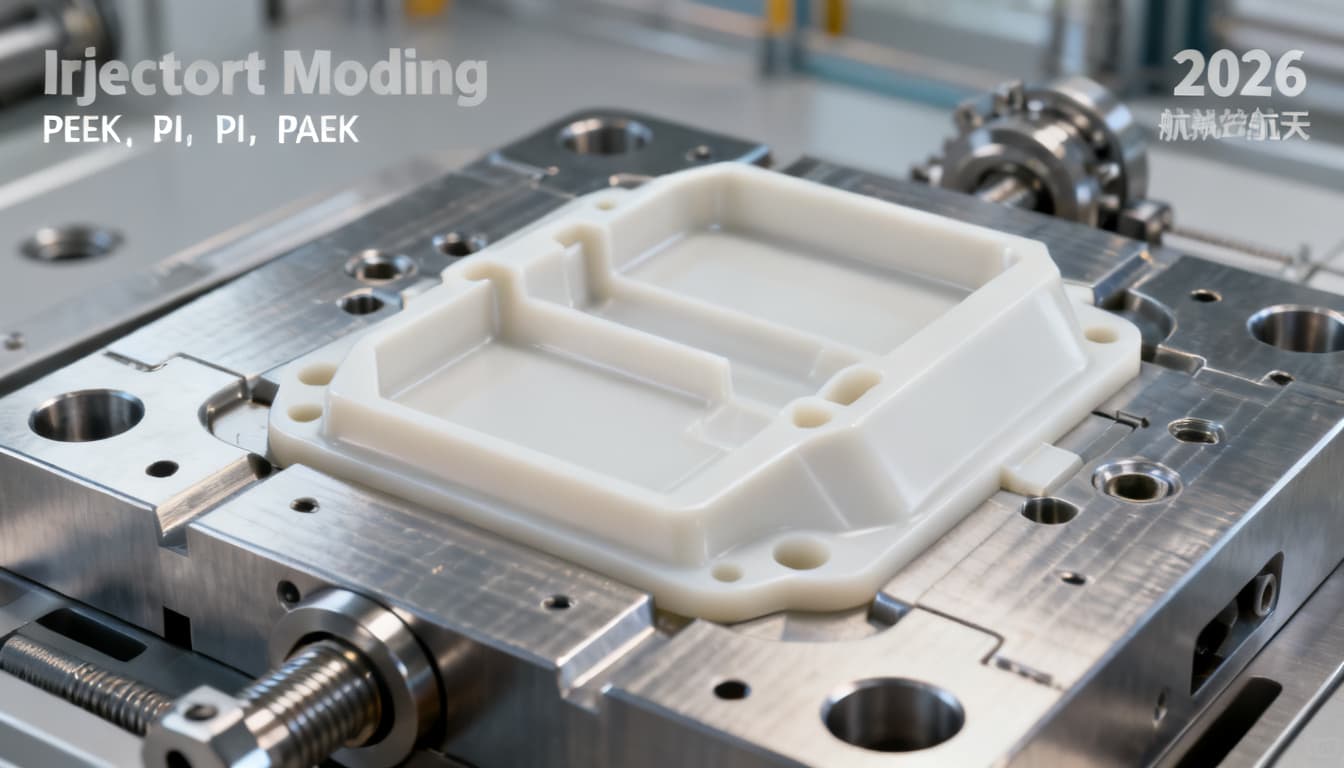
2026 Aerospace Injection Molding Best Practices: Processing PEEK, PEI, and PAEK Under AS9100 with Full Digital Traceability
When a defense contractor’s quality manager sent photos of PEEK connector housings that had started cracking on the assembly line—parts from the same production batch, same material lot, same supplier, yet some perfect and some failing—the root cause wasn’t the polymer grade. It was inconsistent pro
Why PEEK Parts Fail at 180°C: The Real Reason Engineers Are Switching Molders
When a defense contractor’s quality manager sent photos of PEEK connector housings that had started cracking on the assembly line—parts from the same production batch, same material lot, same supplier, yet some perfect and some failing—the root cause wasn’t the polymer grade. It was inconsistent processing. As reported by ABIS Mould, this event forced a deep dive into how seemingly identical molding cycles can produce wildly different crystalline morphology, especially in semi‑crystalline materials like PEEK. The takeaway? Specifying PEEK isn’t protection; precision molding is.
You’re likely reading this because you’ve seen a similar failure. ZetarMold’s processing guide notes that most engineers who inquire about PEEK for a new program have been sent there by a failure mode—a part that cracked at 180°C, corroded in hydraulic fluid, or failed sterilization. At 180°C, unreinforced PEEK still holds >50% of its room‑temperature stiffness, but if the part crystallinity is off by as little as 10%, stress‑relaxation cracks nucleate around molded‑in stresses. The failure isn’t the material; it’s the thermal history locked into the part during molding. That’s why in 2026 aerospace programs, the conversation has shifted from “Is PEEK strong enough?” to “Can your molding process prove every shot was identical?”
These two cases illustrate the article’s core argument: processing precision, not material selection alone, determines field reliability. In the following sections, we’ll look at what it takes to mold high‑performance thermoplastics like PEEK, PEI, and PAEK under AS9100 with full digital traceability—and where most supply chains fall short.
Why Your Standard Injection Molding Machine Can't Process PEEK—And What It Takes
Walk into a typical molding shop and ask if they can run PEEK. Many will say yes because they have a 400°C barrel and a mold heater. But try to hold the melt at 360–400°C with a residence time window of less than 5 minutes without degrading the polymer, while simultaneously keeping the mold steel at 180–220°C with ±3°C uniformity, and you immediately separate the capable from the dangerous. PEEK’s melting point is about 343°C, and processing requires barrel temperatures in the 360–400°C range with screw and check‑ring designs that minimize shear heating. ZetarMold’s guide emphasizes that oil‑heated molds are non‑negotiable—cartridge heaters alone can’t maintain the temperature consistency across multi‑cavity tools because PEEK crystallizes rapidly once the melt drops below 280°C. If mold temperature fluctuates, crystallinity varies, and dimensions drift.
PEI (Ultem) processes at an intermediate window of 340–370°C with mold temperatures of 120–180°C, but still demands hardened steel tooling and proper drying. PAEK grades can be more forgiving on melt temperature but often require even tighter control of cooling rates because of their semi‑crystalline nature. PTSMAKE’s material overview notes that the higher processing temperatures for PEEK translate to greater energy consumption and specialized tooling, while Propprose’s ASTM F2026 data sheet and RapidDirect’s aerospace material benchmarks provide baseline physical properties. The table below consolidates the key processing and performance parameters you need to validate before placing an order.
| Parameter | Unreinforced PEEK | 30% Glass‑Filled PEEK | PEI (Ultem 1000) | PAEK (unfilled) |
|---|---|---|---|---|
| Melt Temperature (°C) | 360–400 | 360–400 | 340–370 | 340–380 |
| Mold Temperature (°C) | 180–220 | 190–230 | 120–180 | 160–210 |
| Continuous Operating Temp (°C) | 250 | 260 | 170–200 | 240–260 |
| Tensile Strength (MPa) | 90–100 | 160–180 | 105–110 | 90–110 |
| Density (g/cm³) | 1.32 | 1.50–1.54 | 1.27 | 1.28–1.32 |
| Drying Requirement | 3‑4 hr @150°C | 3‑4 hr @150°C | 4‑6 hr @150°C | 3‑4 hr @150°C |
| Typical Mold Steel | H13 / Stavax | Hardened H13 / D2 | Hardened H13 | Hardened H13 |
What the table doesn’t show is the sensitivity to residence time. PEEK and PAEK grades degrade if held at melt temperature longer than 5‑7 minutes; shot size should consume 50–80% of barrel capacity to maintain a fresh melt stream. If a molder runs a 200‑ton press with a 6‑oz barrel to mold a 0.5‑oz PEEK connector, thermal degradation is guaranteed. Oil‑heated molds with separate temperature zones become mandatory once cavity count exceeds four. And because PEEK is a semi‑crystalline material, shrinkage is anisotropic—0.6–1.2% depending on flow direction and filler orientation—so mold design must compensate with flow‑analysis‑driven gate placement. Ignore these fundamentals and you’ll end up with parts that look right off the press but crack on the assembly line six months later.
PEEK vs. PEI vs. PAEK: Where the Performance-Cost Trade-Off Really Bites
It’s tempting to treat PEI (Ultem) as a budget‑friendly substitute for PEEK, especially when a datasheet shows both of them can handle continuous temperatures above 170°C. ZetarMold explicitly warns: “PEEK and PEI offer equivalent performance, making PEI the obviously better choice at its lower cost” — false. PEI is an amorphous thermoplastic; it has excellent flame, smoke, and toxicity (FST) properties and works brilliantly for interior brackets, but it is not a drop‑in replacement for semi‑crystalline PEEK in aggressive chemical or thermal cycling environments. Understanding where each material excels—and where it fails—is the difference between a 30‑year service life and a field recall.
A third player, PAEK (polyaryletherketone), is gaining ground in structural aerospace components. PatSnap’s 2026 thermoplastic aerospace patent analysis points to Boeing’s hybrid co‑welding patents, Safran’s seat component filings, and Haumea Tech’s recent PAEK innovations as leading indicators. PAEK delivers superior interlaminar curved beam strength compared to PEEK and PPS while processing at lower temperatures—a combination that directly addresses both structural performance and manufacturing cost. Yet sourcing PAEK parts requires a molder who understands that its lower melt viscosity and different crystallization kinetics demand distinct process recipes, not just a dial‑turn from PEEK settings.
The comparison table below, built from RapidDirect’s aerospace injection molding benchmarks and Machinery Network’s technical overview, makes the trade‑offs explicit.
| Metric | PEEK (unfilled) | PEI (Ultem) | PAEK (unfilled) | Selection Criteria & Failure Boundary |
|---|---|---|---|---|
| Continuous Operating Temp | 250°C | 170–200°C | 240–260°C | Choose PEEK or PAEK for >200°C hot‑zone applications; PEI only for interiors. |
| Chemical Resistance (Skydrol, hydraulic fluid) | Excellent — no stress cracking | Moderate — stress cracking risk at elevated temps | Very good — comparable to PEEK | Any fluid‑wetted component: PEEK or PAEK. PEI fails in prolonged exposure. |
| FST Properties | Good; needs additives for OSU | Excellent — meets FAR 25.853 out‑of‑box | Good; similar to PEEK | Interior panels & seat frames: PEI leads. Exterior fairings: PEEK/PAEK. |
| Melt Temp Range | 360–400°C | 340–370°C | 340–380°C | PEI and PAEK are easier on tooling, but PEEK demands highest thermal investment. |
| Relative Material Cost | $$$$ | $$-$$$ | $$$-$$$$ | PEI offers 20‑40% cost savings over PEEK in non‑fluid applications. |
The cost advantage of PEI disappears the moment you need sustained contact with aerospace hydraulic fluids at 180°C. In those conditions, amorphous PEI absorbs fluid and undergoes environmental stress cracking, while the crystalline structure of PEEK and PAEK acts as a barrier. That’s why you see PEEK in engine‑area connectors, thrust reverser components, and hydraulic seals, and PEI in cabin air grilles, tray tables, and interior lighting housings. PAEK sits between them, often replacing PEEK in structural clips and brackets where its higher interlaminar toughness and lower processing temperature reduce both part weight and cycle time—provided the molder has a validated PAEK‑specific process window.
AS9100D Is Just the Start: Full Digital Traceability from Pellet to Part
For flight‑critical injection molded parts, AS9100 certification is the floor. The standard requires documented material lot traceability, process validation through First Article Inspection (FAI) per AS9102, control of non‑conforming product, and a closed‑loop corrective action system. RapidDirect’s aerospace sourcing guide highlights that certifying bodies expect you to demonstrate the entire chain, from resin certificate of analysis to the final dimensional report. But a paper‑based certificate of conformance for the material lot isn’t enough anymore.
In 2026 aerospace programs, full digital traceability means that every shot is instrumented and logged: melt temperature, injection pressure profile, hold pressure, cooling time, mold temperature per zone, and even screw recovery time. That dataset is linked to a unique part serial number or QR code on each component (or lot‑level for high‑volume interior parts). If a field failure occurs, you can pull up the exact molding parameters for that specific part and compare them against the golden‑batch reference. Suppliers are now embedding cavity pressure sensors in production tools and streaming data to a MES (Manufacturing Execution System) that automatically flags any shot outside the validated envelope. Parts from flagged shots are quarantined, not shipped.
This level of traceability transforms audit readiness. Instead of sifting through paper logs, an AS9100 auditor can review digital thread reports showing that 100% of shipped parts were made within the approved process window. When combined with material lot genealogy (resin lot → dryer conditions → press → cavity → part ID), you have a forensic‑quality trail. It’s not just about compliance; it’s about containment. If a resin lot is later found to be suspect, you can identify every part molded from that lot in minutes and avoid a line‑wide recall. That’s why primes now expect full digital traceability even for class‑C brackets—it’s becoming a procurement differentiator.
Sourcing Timelines and Design Pitfalls: Practical Rules for PEEK Parts
Your sourcing timeline for PEEK, PEI, or PAEK parts must account for tool steel procurement, mold heating integration, and AS9100 validation, not just machine time. MoldItQuick’s PEEK injection molding guide indicates typical bands: rapid prototype tooling in 7–12 days (with hardened steel inserts required, unlike soft aluminum tools for ABS), and production tooling at 25–30 days for automotive class, extending to 45 days for aerospace multi‑cavity tools. After tool validation, AS9100 documentation and FAI can add 1–2 weeks. The table below gives you a realistic planning framework.
| Phase | Standard Engineering Resins (ABS, Nylon) | PEEK / PEI / PAEK (Aerospace) | Key Risk Factor |
|---|---|---|---|
| Prototype Tooling | 5–8 days | 7–12 days | Hardened steel inserts for high‑temp; oil channel design |
| Production Tooling Lead‑time | 15–25 days | 25–30 days (up to 45 for complex multi‑cavity) | Heat‑treat cycle for steel; thermal uniformity validation |
| AS9100 FAI & Process Validation | N/A | 1–2 weeks after tool approval | Dimensional stability study across 100+ shots |
| First Shipment from Tool Qualification | Immediate | Immediate if process is locked | Any subsequent mold maintenance must re‑validate digital process record |
Beyond timelines, design for PEEK and PAEK demands wall‑thickness uniformity within ±0.1 mm in the flow direction. Abrupt thickness changes cause differential cooling and warpage. Gate placement should be in the thickest section with a generous land and a round or trapezoidal gate to avoid premature freeze‑off at 200°C mold temperature. Unreinforced grades work for complex geometries that need ductility; glass‑filled grades provide stiffness and dimensional stability but at the cost of flow length and weld‑line strength. ZetarMold’s processing guide stresses that if the molder does not have a documented shrinkage study for the specific grade and color you are using, you’re flying blind. Always demand a shrinkage factor derived from a 3‑axis measurement study on a similar geometry—not a generic datasheet value.
Red flags in supplier selection: lack of in‑house material drying capability (PAEK and PEI are hygroscopic, and even brief exposure to ambient moisture degrades mechanical properties), reliance on general‑purpose presses without oil‑heated mold temperature controllers, and no record of AS9100 pre‑qualification. These aren’t inconveniences; they are predictors of non‑conformance in your first shipment.
Your Toughest Aerospace Molding Questions: PEEK, PEI, PAEK Under AS9100
Q: Can PEI (Ultem) really replace PEEK in continuous 180°C hydraulic fluid environments?
No—though PEI’s continuous operating temperature can reach 200°C in air, prolonged exposure to aggressive hydraulic fluids like Skydrol at elevated temperatures causes environmental stress cracking. Amorphous PEI absorbs fluid molecules, which plasticize the polymer and accelerate crack propagation under even modest tensile loads. PEEK’s semi‑crystalline structure is inherently resistant to this failure mode. PEI may work for interior brackets or ducting that never sees fluid contact, but never for fluid‑wetted dynamic components without extensive, long‑term testing that replicates the exact fluid chemistry and temperature cycling.
Q: What traceability documentation must we demand from a molder for AS9100 audit compliance?
At minimum, you need a certificate of conformance for each material lot (with resin manufacturer’s batch number and date), a digital log linking each part or lot to the molding machine parameters (cycle time, melt temperature, injection pressure profile, mold temperature, and hold pressure), and a chain‑of‑custody report from pellet receiving through finished part shipment. Forward‑thinking molders provide a digital thread with unique part QR codes that pull up the full shot history. In an audit, you must be able to demonstrate that every shipped part was made within the validated process envelope and that the material lot matches the one on the original FAI.
Q: How do prototype lead times for PEEK parts compare to standard engineering resins?
Expect 7–12 days for rapid prototype tooling, which is slightly longer than the 5–8 days typical for ABS or nylon because the mold must incorporate hardened steel inserts and possibly conformal cooling/heating channels to maintain the 180–220°C mold surface temperature. Prototype tools for PEEK are not throw‑away aluminum; they need to survive multiple shots at elevated temperatures without losing dimensional accuracy. Production tooling for aerospace PEEK parts runs 25–30 days for simple geometries, but AS9100 first article inspection and process validation can add 1–2 weeks before serial production starts.
Q: What are the red flags when sourcing PAEK parts from a new supplier?
Look for absence of in‑house desiccant drying capability with dew‑point monitoring (PAEK is hygroscopic and requires consistent moisture content below 0.02% before molding). A molder relying on general‑purpose presses without oil‑heated molds will struggle with the precise cooling‑rate control that PAEK’s crystallization demands. The biggest red flag: no documented shrinkage study for the specific PAEK grade you intend to use. If they treat PAEK as just another PEEK with a lower melt temperature, the dimensional stability and mechanical performance will suffer because PAEK’s lower melt viscosity and different crystallization kinetics alter flow‑induced orientation and shrinkage anisotropy.
Q: Is full digital traceability worth the added cost on non‑critical aerospace brackets?
For non‑critical cabin brackets, full traceability may not be a regulatory mandate, but it significantly reduces supply‑chain risk. If a problem ever surfaces—a bad resin lot, a mold heater drift—a fully traceable batch lets you pinpoint the affected parts by serial number without a line‑wide recall that could ground an aircraft for days. Many prime contractors now mandate digital traceability even for class‑C parts as a condition of doing business, because the alternative is trusting a paper trail that often fails under audit scrutiny. The incremental cost of instrumenting the mold and logging data is a fraction of the cost of a field containment action.
References & Further Reading
- PEEK Injection Molding: Processing Guide for Engineers — ZetarMold
- Aerospace Plastic Injection Molding: Key Components, Design Considerations — ABIS Mould
- Aerospace Injection Molding: PEEK, AS9100 & Sourcing Guide — RapidDirect
- Thermoplastic Composite Aerospace Structures 2026 — PatSnap Insights
- PEEK Injection Molding Guide: Process, Mold Design & Applications — Molditquick
- PEEK Injection Molding Properties — Complete Engineering Data Sheet (2026) — Propprose
- Discover PEEK: The Ultimate Material for Extreme Uses — PTSMAKE
- Plastic Injection Molding for Aerospace Components: Technical Guide — Machinery Network
When you’re ready to pair AS9100‑compliant processing with full digital traceability for your next PEEK, PEI, or PAEK program, get a quote from PandaMolding. Our engineering team will review your geometry, material spec, and traceability requirements to deliver a process‑validated solution that passes audit the first time.